
SEO Product Page Email: salesexp@nbshzl-motor.com
Brushless Gearbox

Brushless Gearbox — Factory-Paired Planetary / Spur / Worm Gearboxes With BLDC Motor.

Mechanical engineers buy "the gearbox". Electrical engineers buy "the gear motor". Same product, different framing — and on Shenghe's production line, both come off the same dyno bench at end-of-line. This page is the gearbox-side framing: planetary, spur, and worm brushless gearboxes manufactured in-house at Cixi (Ningbo) and integrated with BLDC motors before the buyer takes delivery. One PO, one dyno test record per unit, one warranty covering motor + gearbox + bearings + oil seal as a single product.

  • Three gearbox families — planetary (1/2/3-stage), spur (1/2-stage), worm (single-stage)
  • Voltage 12V / 24V / 36V / 48V / 72V DC; ratios 3:1 to 500:1; torque 0.5–300 N·m
  • Backlash <5 arc-min (planetary Q12 ground) / 30–60 arc-min (spur) / 30–90 arc-min (worm)
  • IP54 standard; IP65 upgrade; NSF H1 food-grade lubricant on request
  • Sample 7–10 days; production 2–3 weeks ex-Cixi factory
Single Factory Motor + Gearbox + Test
1 Dyno Test Per Unit, As Integrated Drive
1 Warranty Across Motor + Gearbox
ISO 9001 + CE + RoHS
20 min from Ningbo-Zhoushan Port
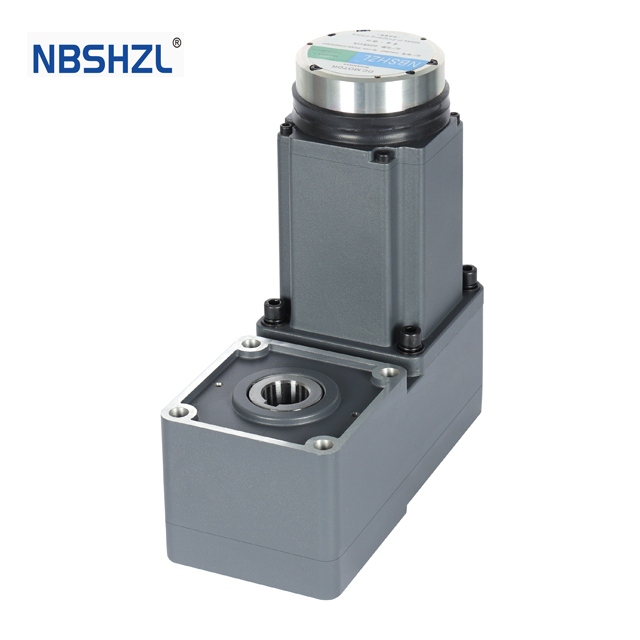
Shenghe brushless gearbox — BLDC motor + planetary gearbox integrated unit with coaxial output flange, factory-paired and dyno-tested as one assembly.
L-type brushless gearbox — BLDC motor + planetary gearbox + output flange as one integrated drive, not a two-supplier bolted assembly.
The Reframing That Matters

Why Buy The Gearbox With The Motor Already In It.

A brushless gearbox is what you order when you don't want to spend three weeks managing the interface between a German gearbox supplier and a Chinese motor supplier — adapter plate machining, coupling concentricity, datasheet reconciliation, two warranties, two repair channels. On Shenghe's production line, the gearbox input pilot is bored from the same fixture as the motor mounting flange; the unit is grease-packed and sealed in one operation; the dyno bench measures output torque at the gearbox shaft, not at the motor shaft.

  • One PO instead of two — single HS Code on the commercial invoice
  • One dyno test record covering motor input current, gearbox output torque, no-load current, backlash, noise
  • One warranty boundary covering bearing wear, oil-seal leak, gear-tooth pitting and stator failure as a single product
  • One sourcing relationship to manage — engineering response on motor + gearbox is the same channel
Gearbox Families

Three Brushless Gearbox Families — Planetary, Spur, Worm.

Pick the gearbox family from the mechanical requirement; the BLDC motor variant is determined by the voltage / power / control needs once the gearbox is fixed.

Family Ratio range Backlash Efficiency Self-locking Best-fit applications
Planetary 3:1 to 500:1 (1 / 2 / 3-stage) 5–10 arc-min (1-stage); 10–20 (2-stage); 15–30 (3-stage); <5 arc-min on Q12 ground ~94% per stage No (back-drivable) Robot joints, AGV traction, precision positioning, medical pumps, drone gimbals
Spur / Helical 3:1 to 100:1 (1 / 2-stage) 30–60 arc-min single-stage; 45–90 arc-min two-stage ~90–95% No (back-drivable) Conveyor drives, light packaging machinery, fans, basic actuators where cost dominates
Worm 5:1 to 60:1 single-stage; combinable to 200:1 30–90 arc-min (tooth count + lead angle dependent) 70–85% (sliding contact) Yes (lead angle <5°) Lifts, automatic doors, barriers, conveyor stops, holding-position actuators

Back-drivability matters when the load must hold position with the motor de-energised. Planetary and spur gearboxes are back-drivable — add an electromagnetic brake on the motor (available on 80mm+ frames). Worm gearboxes with lead angle <5° are naturally self-locking — the load can't drive the motor backwards. This is why lifts, automatic doors, barriers and motorised valves use worm: no power = no movement.

Motor Pairing

Which BLDC Motor Variant Gets Paired With Which Gearbox.

The gearbox determines the mechanical answer; the motor variant determines the electrical answer. Both come from the same factory and are dyno-tested as a unit before shipment.

Application class Voltage Power Typical gearbox BLDC motor variant Controller
Lab automation / medical pump / drone gimbal 12V DC 10–200 W Planetary 1-stage or 2-stage, 22–42 mm Standard BLDC with Hall sensors BLD22010
AGV (light) / packaging / robot joint / automatic door 24V DC 50–500 W Planetary 2-stage, 42–57 mm; or worm for self-locking BLDC with Hall sensors; servo with encoder for precision BLD22010 or BLDB6010 (servo)
AGV (heavy) / e-cargo / industrial valve actuator / conveyor 48V DC 500–1,500 W Planetary 2-stage or 3-stage, 57–86 mm; helical for continuous duty BLDC with regen-braking compatible controller BLD6010
E-rickshaw / electric forklift / heavy AGV lift / sluice gate 72V DC 1,000–3,000 W Planetary 3-stage 200:1–500:1; or heavy worm with self-locking High-current BLDC with regen-braking BLD6010
Precision positioning / collaborative robot joint 24V / 48V DC 100–800 W Planetary 1-stage or 2-stage Q12 ground gears (<5 arc-min backlash) BLDC servo with encoder + FOC commutation BLDB6010 servo

Controller specifications: BLD22010 covers DC 18–60V at 10A continuous (24V/36V/48V motors up to ~500W); BLD6010 covers DC 80–220V at 30A continuous (72V/110V/220V motors up to 3kW); BLDB6010 is the FOC servo controller with encoder feedback for sub-1-arc-min positioning. See /products/motor-controller/ for the controller Hub and matched-kit details.

Construction & Material

What's Actually Inside The Gearbox Housing.

Component Material Heat treatment / surface Standard
Planetary sun + planet + ring gears 20CrMnTi case-hardening steel Carburised + quenched; surface HRC 58–62, core HRC 32–40 AGMA Q9–Q11 standard; Q12 (DIN 6) ground on request
Spur / helical gears 20CrMnTi or 40Cr Quenched and tempered; surface HRC 50–55 AGMA Q9–Q10
Worm shaft 40Cr quenched-tempered + ground steel Surface HRC 45–50, profile ground AGMA Q9
Worm wheel (paired with worm shaft) ZCuSn10P1 tin-bronze Bronze hardness HB 80–110 AGMA Q9 matched to worm shaft
Output shaft 45 carbon steel or 40Cr Quenched and tempered; surface HB 220–280 Tolerance h6 standard
Bearings GCr15 / SUJ2 bearing steel Through-hardened HRC 60–65 P5 / P6 manufacturer accuracy class
Housing Cast aluminium ADC12 (small/medium); 45 steel or cast steel (heavy) Machined to bore tolerance for input pilot + output bearing seats
Output oil seal NBR rubber lip + spring + dust-lip (standard); FKM for IP65 Dual-lip; IP54 standard, IP65 with FKM upgrade
Lubricant Lithium-complex grease NLGI 2 (planetary/spur); ISO VG 220 EP gear oil (worm) Sealed-for-life from the factory Mobil SHC 460 / Klüber Polylub GLY equivalent; NSF H1 food-grade on request
Six Reasons Procurement Stays

Why Procurement Teams Pick The Brushless Gearbox Over Two-Supplier Integration.

  • Single PO, single shipment, single HS Code (8501) — gearbox + motor as one integrated drive on the commercial invoice and the B/L. No two-supplier coordination, no separate Incoterms.
  • Concentricity is bored in — gearbox input pilot is bored from the same fixture as the motor mounting flange; the coupling between motor shaft and gearbox input runs concentricity error inside one tolerance budget, not the stack-up of two suppliers' budgets.
  • Dyno-tested as a unit — output torque measured at the gearbox shaft (not the motor shaft) on every unit; backlash measured at the output flange (not the gear mesh) — what you read on the test sheet is what the machine designer will see at the load.
  • One warranty, one repair channel — failure analysis isn't a finger-pointing exercise between two suppliers; Shenghe owns root cause whether it's bearing wear, oil-seal leak, gear-tooth pitting or stator burn-out.
  • Engineering response on motor + gearbox is the same channel — when the project calls for a 30:1 ratio change or a custom shaft length or a regen-braking firmware option, the engineering team that quotes the change owns both the gearbox and the motor.
  • Audit-welcomed factory — SGS / BV / Intertek / TUV third-party audits supported; live WhatsApp video walk-through with random unit teardown at the assembly station for buyers who can't visit.
Send The Spec

Brushless Gearbox Sizing Inquiry.

Send gearbox family + ratio + output torque target + voltage + duty cycle + IP requirement. Engineering will return a frame + ratio + motor variant recommendation with the dyno-projected continuous-duty figures.

WhatsApp
FAQ

What Procurement And Engineering Ask Before The First PO.

What is a brushless gearbox?
A reduction gearbox (planetary, spur, or worm) paired with a brushless DC (BLDC) motor as one integrated unit. Mechanical engineers buy "the gearbox"; electrical engineers buy "the gear motor" — same product, different procurement framing. Shenghe manufactures both sides under one roof in Cixi (Ningbo) and ships them as one dyno-tested drive.
Brushless gearbox vs brushless gear motor — same thing?
Same physical product, different framing. Pick the term that matches how your engineering team thinks about the project. See /bldc-gear-motor/ for the motor-led catalog and /products/gear-motor/ for the full gearbox-family browse.
What backlash spec is achievable on a planetary brushless gearbox?
Q9–Q11 standard: 5–10 arc-min (1-stage), 10–20 (2-stage), 15–30 (3-stage). Q12 ground gears on request drop 1-stage below 5 arc-min and 2-stage below 10 arc-min. Spur: 30–60 arc-min single-stage. Worm: 30–90 arc-min depending on tooth count + lead angle. Backlash measured at the output flange on the per-unit dyno bench.
Self-locking — when does it matter?
Worm gearboxes with lead angle <5° are self-locking — the load cannot back-drive the motor when power is off. This matters on lifts, automatic doors, barriers, and motorised valves where the load must hold position without the motor energised. Planetary and spur gearboxes are back-drivable — add an electromagnetic brake to the motor (available on 80mm+ frames) if you need holding torque on a planetary or spur unit.
What IP rating ships standard?
IP54 on all stock SKUs (double-lip oil seal, housing O-ring, sealed motor-side bearings). IP65 with FKM seal + double O-ring + IP65 cable gland on request. IP67 submerged-grade quoted per project. NSF H1 food-grade lubricant available as a custom modification.
Can I get a custom ratio?
Yes. Stock-tooling custom (different tooth count on existing gear blanks): 50-unit MOQ, 3–4 weeks. New-tooling ODM: 200-unit MOQ, 12–20 weeks. See /odm-bldc-motor/ for the ODM engagement model.
What's the voltage range on the paired BLDC motor?
Standard: 12V / 24V / 36V / 48V / 72V DC. Each voltage maps to a different controller (BLD22010 for 24V–48V at <10A; BLD6010 for 48V–220V at <30A; BLDB6010 for FOC servo). Custom voltage tap on existing motor windings: see /custom-bldc-motor/.
Why does single-source factory matter?
Three failure modes that two-supplier integration creates: (1) concentricity stack-up between gearbox input and motor shaft drives premature bearing wear; (2) duty-cycle spec mismatch under intermittent automation duty undersizes the integrated unit by 1.5–2×; (3) warranty boundary becomes a finger-pointing exercise. Single-source eliminates all three.
MOQ and lead time?
Sample 1 unit, 7–10 days. Production 100 units, 2–3 weeks. Custom ratio 50–100 units, 3–4 weeks. Custom modification 100–300 units, 6–8 weeks. ODM 200–500 units, 12–20 weeks. Volume tier pricing: see /bldc-motor-wholesale/.
Payment and shipping?
T/T 30% deposit on PO + 70% balance against B/L copy. L/C at sight on orders >USD 30k. PayPal on samples <USD 1k. Tooling milestones for ODM. EXW Cixi / FOB Ningbo / CIF / CFR / DAP / DDP available. Ningbo-Zhoushan port 20 min away.